Turmeric extract 95% curcuminoids: a buyer's specification guide
What a 95% curcuminoid specification really covers, how it is tested, and the documents to request before you approve a turmeric root extract supplier.
· 3 min read · YVELIA Editorial Team
Turmeric root extract standardised to 95% curcuminoids is one of the most traded botanical extracts in the world, and one of the most frequently questioned at supplier approval. The number on the label is only the start: how it was measured, which curcuminoids make it up and what else is in the drum decide whether a lot passes your QA. This guide sets out what professional buyers check before they approve a turmeric extract supplier.
Powder or extract: start with the format
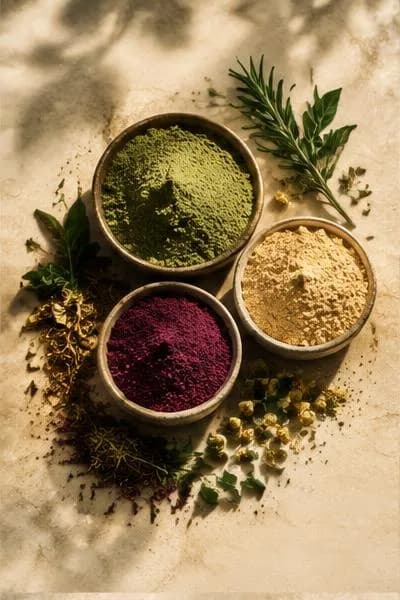
Turmeric powder is the dried, milled rhizome and naturally contains only a few per cent curcuminoids. It suits foods, golden-milk lattes and whole-food positioning, where colour and flavour matter as much as the marker. A 95% extract is solvent-extracted, purified and dried, so a few hundred milligrams deliver a defined, consistent level — the reason it dominates capsule and tablet formulas.
Many ranges use both: high-curcumin turmeric powder for a latte or blend, and turmeric extract 95% for a capsule in the same brand family.
What "95% curcuminoids" means
Curcuminoids are a group of three compounds: curcumin, demethoxycurcumin and bisdemethoxycurcumin. A 95% specification refers to the total of the three, not to curcumin alone. A typical split is roughly three-quarters curcumin with the remainder shared between the other two, but it varies with raw material and process — so ask for the split to be reported, not just the total.
HPLC or UV?
Curcuminoids can be measured by UV spectrophotometry or by HPLC. UV is faster but reads other compounds that absorb at the same wavelength, so it tends to give higher figures. HPLC separates and quantifies each curcuminoid individually and is the method most UK, EU and Australian QA teams expect. Agree the method in the specification; a "95% by UV" lot and a "95% by HPLC" lot are not the same product.
The specification to agree
Identity: Curcuma longa rhizome, extraction solvent, and the marker method (HPLC)
Total curcuminoids and the individual split
Appearance: orange-yellow powder, characteristic odour; mesh size and bulk density for your encapsulation line
Loss on drying and ash
Residual solvents against ICH Q3C or your destination's limits
Heavy metals: lead, cadmium, arsenic and mercury
Pesticide residues, including ethylene oxide where the destination tests for it
Microbiology: total plate count, yeast and mould, E. coli, Salmonella
Bioavailability and pairing
Curcumin is poorly absorbed on its own, which is why so many formulas pair it with black pepper extract (piperine). Others use water-dispersible or excipient-based forms. Each choice changes the specification and, in some markets, the regulatory review: piperine has maximum-level guidance in several countries, and some enhanced forms may raise novel-food questions in the UK and EU. Settle the delivery form before you request final quotes.
OEM and private label options
If you formulate in-house, buy the extract in bulk and run your own process. If you want a finished product, turmeric extract can be built into capsules, tablets, gummies or a blend such as YVELIA+ GOLDEN+ through YVELIA's manufacturing network, as an OEM or private label product. The Solutions page explains how the routes differ.
Claims: keep them on the right side of the line
In the UK and EU, curcumin and turmeric health claims are still "on hold", so on-pack wording should describe traditional use rather than a health effect. Australia and the GCC have their own rules. Whatever a published study used, any claim on your pack is yours to substantiate in your market — see our guide to importing food supplements into the UK.
Documents to request
Ask for a batch COA with the HPLC chromatogram, a technical data sheet, residual-solvent and pesticide reports, allergen and GMO statements, and the country-of-origin documents your importer needs. Our export documentation checklist lists them by destination.
Frequently asked questions
Is 95% curcuminoids the same as 95% curcumin?
No. 95% curcuminoids is the total of curcumin, demethoxycurcumin and bisdemethoxycurcumin. Curcumin itself is usually the largest share, so ask for the split on the COA.
Which test method should a turmeric extract COA use?
HPLC, which quantifies each curcuminoid separately. UV methods tend to read higher, so a lot tested by UV is not directly comparable.
Can turmeric extract be supplied as a finished private label product?
Yes — as capsules, tablets, gummies or blends through YVELIA's manufacturing network. MOQ and lead time are confirmed on enquiry.
About the author
YVELIA Editorial Team
Sourcing, quality & export documentation
The sourcing, quality and export-documentation team at YVELIA Global Impex LLP in Ahmedabad, India. These guides answer the questions buyers in the GCC, UK, Australia and South Africa ask us most — specifications, documents and market rules. Regulatory notes are orientation, not legal advice, and are reviewed at least once a year.
More about YVELIA